


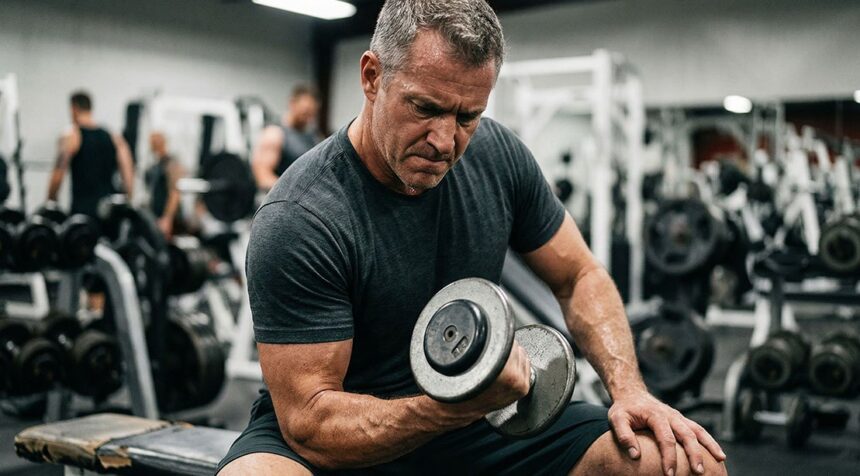
The biggest mistake beginners make when training arms is believing they need a dozen different curl variations to confuse the muscle into growing. Forget muscle confusion. Your biceps aren’t confused—they’re underworked. Growth comes from progressively challenging the muscle, not from inventing new ways to curl a dumbbell.
In my last installment I talked about how biceps grow. I covered the Growth Equation, the importance of time under tension, why intensity always trumps volume, and why the often-overlooked brachialis muscle deserves as much attention as the biceps itself. Now it’s time to put all that knowledge to work.
Remember, your biceps are relatively small muscles. They also assist during virtually every heavy back exercise you perform. Pull-ups, chin-ups, pulldowns and rows all recruit the biceps secondarily. By the time arm day rolls around, they’ve already been doing their share of the work. That means quality is far more important than quantity. These four exercises are more than enough to have your biceps blasted by the time you’re finished.
The 4 Bicep Exercise Workout For Bigger Arms
Standing Barbell Curl:
4 sets, 12, 10, 8, 8 reps
Start your workout with standing barbell curls. Nothing fancy. Just you, a barbell and strict form. Forget swinging the weight, rocking backward or turning the exercise into a full-body Olympic event. Your elbows should remain close to your sides while the biceps do the work. If you own an arm blaster, now’s the time to use it. Perform four progressively heavier sets of 12, 10, 8 and 8 repetitions. The first set is simply a warmup. Each set thereafter should increase in weight until those final two repetitions become a genuine battle.
Seated Alternating Dumbbell Curl:
4 sets, 8-10 reps
Once the barbell work is complete, move to seated alternating dumbbell curls. Because the muscle is already warm, there’s no reason to waste energy working back up through several light sets. Pick a challenging weight and perform four sets of eight to ten repetitions, concentrating on squeezing the biceps hard at the top of every repetition before lowering the dumbbell slowly under control. Resist the temptation to let gravity do the work. Remember, lowering the weight is still part of the exercise.
Standing Hammer Curl:
1 warmup set, then 4 sets, 8–10 reps
Now it’s time to show the brachialis a little respect. Standing hammer curls are one of the quickest ways to add thickness to the upper arm because they emphasize the brachialis lying beneath the biceps. As that muscle develops, it literally pushes the biceps upward, making the entire arm appear larger. Perform one light warm-up set followed by four challenging sets of eight to ten repetitions. By now your arms should be questioning every decision you’ve made since walking through the gym door.
Straight or EZ Bar 21s
If you really want to find out what your pain tolerance looks like, it’s time to finish the workout with one of bodybuilding’s oldest and most brutal arm finishers—21’s.
If you were born in the ’90s, you probably think a 21 is an aftermarket wheel. But if you trained in the hardcore gyms before health clubs became social clubs, you know exactly what’s coming.
Twenty-ones are not a primary mass builder. They’re a finisher. By the time you get to them, your biceps should already be thoroughly fatigued. The goal now is to extend time under tension, drive as much blood into the muscle as possible and push yourself right to the edge of failure.
Load a straight bar or EZ-curl bar with a weight you could normally curl for about twenty strict repetitions, then take a little weight off. You’re about to perform twenty-one continuous repetitions divided into three seven-repetition phases.
Begin with seven bottom-half repetitions, curling the bar from full extension to approximately halfway up. Pause briefly at the midpoint before lowering the weight under complete control. Without setting the bar down, immediately perform seven top-half repetitions, beginning at the midpoint and curling to full contraction, squeezing the biceps hard before lowering only to halfway. Finally, perform seven full-range repetitions from the bottom all the way to the top, flexing the biceps as hard as possible on every rep.
If you selected the weight correctly, your biceps should feel like they’re full of wet concrete by the time you finish the set. Rest about ninety seconds and repeat for three or four more rounds if you’re feeling particularly ambitious.
One of my favorite ways to perform 21’s is with a training partner. Stand face-to-face. When you finish your set, don’t rack the bar. Hand it directly to your partner and immediately begin spotting him through his repetitions. As soon as he finishes, he hands the bar right back to you. No sitting down. No checking your phone. No wandering around the gym pretending to recover. Just continuous work until both of you are finished.
Done correctly, you’ll be hard-pressed to find another biceps exercise that’s as physically demanding as it is mentally exhausting. By the last three repetitions of your final set, it should feel like someone is amputating your arm with a dull chainsaw.
It’s a feeling you’ll never experience standing on a Bosu ball.
Lift, Recover, Repeat
Of course, none of this will amount to much if you don’t feed the muscle you’ve just destroyed. Remember the second half of the Growth Equation. Training creates the stimulus. Recovery builds the muscle. That means plenty of lean protein, quality complex carbohydrates, healthy fats, hydration and adequate sleep. Add a quality multivitamin/mineral supplement, enough protein to support recovery and, if you enjoy the extra energy and focus, a well-formulated pre-workout can help fuel a productive session.
Most importantly, be patient.
Nobody builds championship-caliber arms in a month. Building impressive biceps is no different than building an impressive physique. It requires consistency, progressive overload, intelligent nutrition and enough intensity to convince your body that bigger, stronger arms are no longer optional.
Keep showing up.
Keep adding weight.
Keep chasing one more rep.
Do that long enough, and those biceps will be popping!
Read the full article here
