


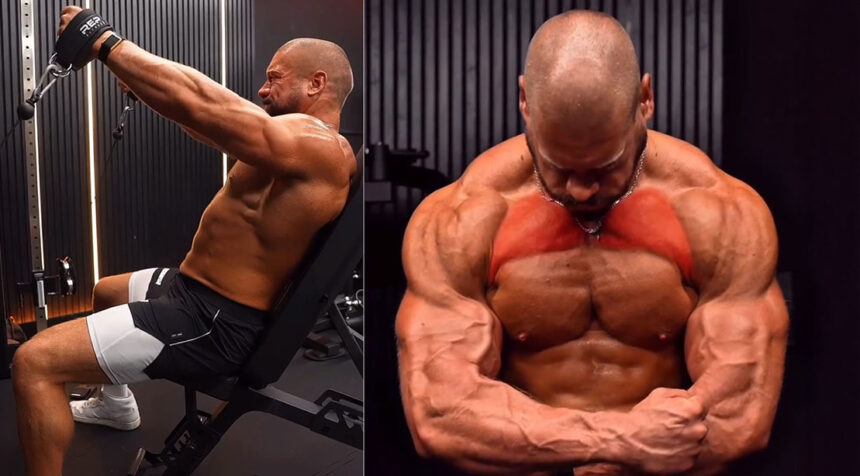
Building a full and muscular chest requires some serious reps, but while the barbell bench press or dumbbell chest press are great choices for blasting your pecs, focusing on the angles is how the pros target more specific areas like the clavicular head, otherwise known as that upper section of the pec — or the mass that gives you that stacked ‘top shelf’ appearance. Fortunately, Davis Diley, who is an evidence-based bodybuilding coach, shared some of his methods in a recent Instagram post.
“The secret to thickening up the clavicular pec fibers is the arm path you use, not the angle of the bench,” wrote the former competitive bodybuilder and strongman, who now teaches millions of followers how to level up their own physiques. Of course, the incline of a bench for presses is important, but it’s next to useless if your technique is all wrong. “On presses and flys, keep your arms tucked closer to your sides,” shared Davis via an informative Instagram post for his 1.4 million followers. “The more you flare your arms out, the less upper pec focused the movement becomes, even if you’re on an incline bench.”
With elbows tucked, Diley explained that the next step is to plan his arm path. “To further optimize the upper pecs, you want the hardest part of the rep to occur when the arms are roughly 40°–90° in front of the body,” he explained. “That’s exactly why we use incline benches for incline presses and flys. They make that specific range harder compared to laying flat.”
In other words, imagine that your arm is straight out in front of you, and you’re completing a press or fly. As you bring the arms in, towards the center of your body, the pec fibers will be recruited, so it is important to bring the arms closer together towards the top of the lift, rather than lift them up straight, since this would be more shoulder dominant. This is easier to accomplish with a fly than a press, but Diley has devised an even more flexible movement on the cable station, utilizing elements of both the press and the fly to really pump up those clavicular heads.
Davis Diley Sets Up the Cables For a Chiseled Upper Chest
In his video demonstration, Diley also showed how to create what he believes to be the perfect setup to hit the upper portion of your pecs. This move looks to be a blend of the front raise and the crossbody fly as he places an inclined bench facing the cable station, and then sets the seat rest angle to 60 degrees. Diley fine tunes the position of the bench so that he gets a 90° angle when the cable is at its lowest position.
“Now, sit back, and push your chest up,” commanded the coach. “Imagine you’re rolling your shoulders back,” he added, noting that he keeps his back flat against the pad. Diley also imagines that he’s driving his fist forward while lifting, but when he gets towards the halfway point, the bodybuilder arches his arm pattern inwards slightly, similar to a fly. “Finish when your elbows reach eye level,” he explained. “This is what perfect form looks like.”
Since the upper pec is linked with shoulder flexion, there will be some deltoid recruitment in this fly variation, much like with an incline bench press, but if you haven’t strayed too far from the barbell recently, mixing things up with cables is a great way to tax your body from all angles. Give this novel method a try, opting for two to three sets of 8 to 12 heavy reps for hypertrophy, and see if it works for you.
To follow Davis Diley on Instagram, click here.
Read the full article here
