


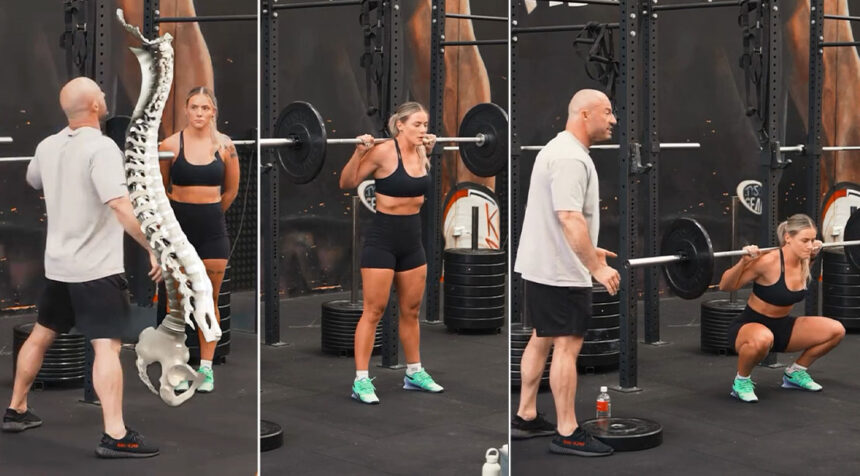
Sebastian Oreb, better known as “The Australian Strength Coach” to his more than half a million followers on Instagram, knows the importance of lifting heavy while staying injury free. And, as the mentor of Hafþór Júlíus Björnsson, the results speak for themselves. So, when Oreb took to social media in order to correct the common flaw of over-arching during squats, it was clear that he had our backs… literally.
Finding the perfect form during traditional back squats can be especially difficult. There are a number of factors to consider, such as foot placement and keeping the barbell stable while resting on the shoulders, but one area that is often confused is how much the back should be arched. Oreb shared that the reason for excessive arching is often caused by the lifter trying to avoid a rounded upper back and shoulders. The problem here is that arching too much creates an extended spine, whereas squats require flexion and range of motion.
“So, a lot of people, to avoid going into flexion, they excessively extend,” explained Oreb. “That does two bad things. One, it elongates our rectus abdominis, the rectus abdominus is six-pack abs. If I was to punch you in the belly, as hard as I can, would you want to lengthen those muscles or contract those muscles?” Now, hopefully you’ll never get punched while priming yourself for a squat, but the illustration serves an important purpose. “Okay, so when we elongate those muscles, we’re not activating those.”
How to Brace Your Core Correctly for Squats
It all starts with the initial brace, explained Oreb, who was accompanied by Bailey Haslam for the detailed demonstration. The Australian Strength Coach explained that while many people remember to inhale as they begin to descend with the bar, some forget to contract their abs. “The way that we contract those, is we bring our ribs towards the pelvis,” he explained.
With this advice, Haslam took a deep breath and contracted her core as she bent her knees and lowered herself. With her core flexed, the arch was naturally narrowed as the spine straightened up. This contracted core then bolstered Haslam’s stability and ability to stand back up with intent.
Why Over-Arching During Squats Is Dangerous
Oreb further explained that elongating the spine during squats causes anterior tilt in the pelvis. “So, the anterior tilt decreases the amount of hip joint flexion that’s available to us,” he shared. The Australian Strength Coach demonstrated that when standing, the hips aren’t flexed, but as his hips lower towards his knees during a squat, hip flexion comes into play. Oreb explained that if the spine is elongated before lowering, then this takes up valuable hip flexion before he even begins the rep. The position of an arched back takes away from the ability to rotate the pelvis.
So, once again, Oreb pointed out the importance of contracting the abs and neutralizing the pelvis position, in order to receive more available degrees of motion during the lowering phase, thus reaching a powerlifting depth more comfortably.
For more tips on finding the perfect form, follow Sebastian Oreb on Instagram by clicking here.
Read the full article here
